- 100 School
- Posts
- 💯 How to 2x your team's AI output without new tools
💯 How to 2x your team's AI output without new tools
Your team already has the tools to double output. Here's what's missing.

Max Haining
April 05, 2026
Anthropic had a bad Tuesday.
Someone accidentally leaked Claude Code's entire source code. Within hours it was mirrored on GitHub. Elon made a joke. OpenAI made a joke.
Whole morning gone.
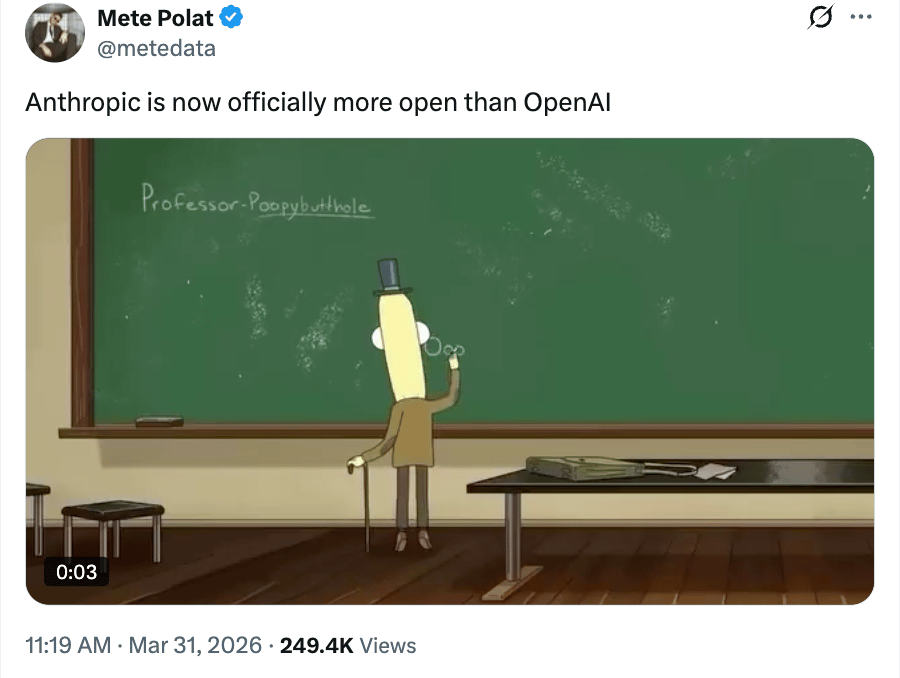
What stuck with me (besides the memes) was one file people found inside.
It runs Claude Code's memory. You'd think a tool that good would remember everything, but it does the opposite. It writes tiny sticky-note pointers to itself, then cleans them up in the background while you work. The rule underneath it is if you can look something up, don't store it. Old memory is worse than no memory.
That's basically the opposite of how most of us use AI. We hoard. We cram every instruction and every bit of context into one massive prompt. The people actually getting value are using small pointers, clean structure, and letting the model fetch what it needs (I wrote a whole issue on this a few weeks back if you want to go deeper).
Turns out that same principle scales. And I just came across the research that proves it.
Window Into the Future 🔮
I just came across something that should change how every company thinks about AI right now.
Researchers at Harvard and INSEAD took 515 startups and split them in two groups. Both groups got the same AI tools (same ChatGPT, Claude, credits, and training). One group was shown stories of how other companies had reorganized around AI (actual workflows, where a human got replaced by a model, and how a team of eight became a team of one).
At the end, that group had nearly double the revenue of the other one. They were shipping faster, signing more customers, and asking for 40% less money to get there. They had the same tools but they had a better idea of where to use them.
The researchers call this the mapping problem.
AI keeps getting better so the individual-task gains are obvious by now, but at the company level the gains are still hard to find.
Most people still can't see where AI fits in their own work. So everyone defaults to the same obvious stuff like a chatbot for support, an AI to draft emails, summarize meetings, etc... Meanwhile the real unlocks sit there undiscovered because nobody ever walked you through what they look like.
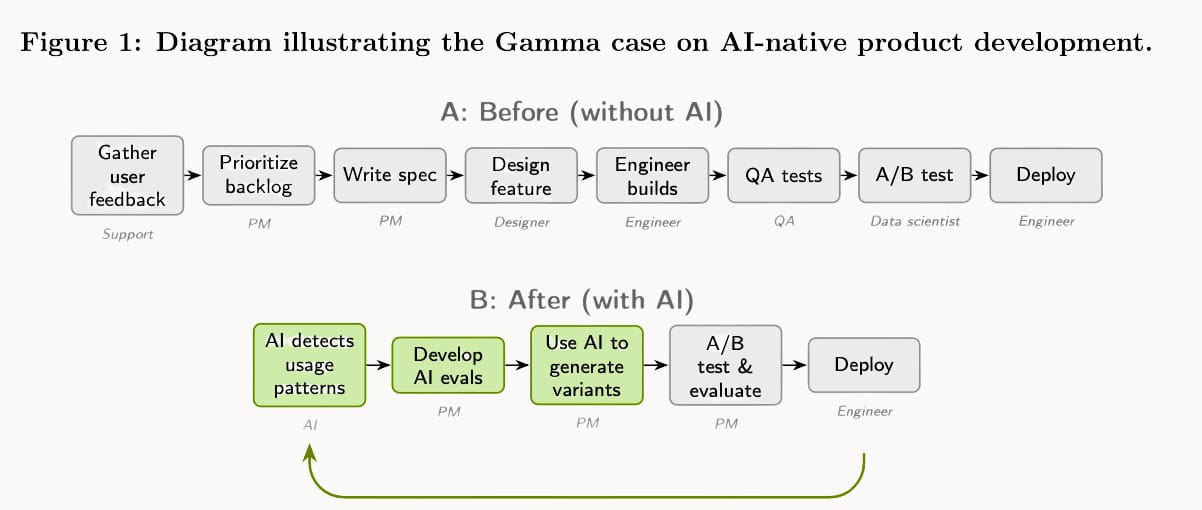
From Kim, Kim & Koning (INSEAD/HBS, 2026).
Here's what that actually looks like in real companies:
🎨 Gamma, the AI presentation tool, is at around $50M in revenue with about fifty people. Instead of designers and product managers arguing about what to build next, they let AI watch how people use the product, spit out a few versions of a new feature overnight, then one person picks the winner in the morning. What used to take a team of eight takes one person now.
🧳 FazeShift rebuilt how companies chase down unpaid invoices. The old way was someone opening four tabs (spreadsheet, accounting software, bank website, email) and copying things across them all day. The new way is AI does all of that in the background, and a person only shows up when something's weird.
🤝 A team we worked with at 100 School with a group of 100+ HR leaders spent fifteen minutes a day for three weeks using Claude and ChatGPT. By the end they built 1,400+ things they could use at work: email sorters, onboarding helpers, little tools to clean up messy data. People who started calling themselves "beginners" had basically all disappeared.
None of these took new hires. Every one of them started with someone asking "where in my week is there a thing I do over and over that AI could just…do?"
Which brings me to something else Anthropic did recently that got less attention than it deserved.
They used Claude itself to interview 81,000 people across 159 countries about how they feel about AI. The top thing people said they wanted from AI was "professional excellence."
It sounds corporate but when Claude pushed on what that meant, the answers were about feeling relief and having more time. One woman in Colombia said AI meant she could cook with her mother on a Tuesday night instead of finishing tasks. That answer is the whole story.
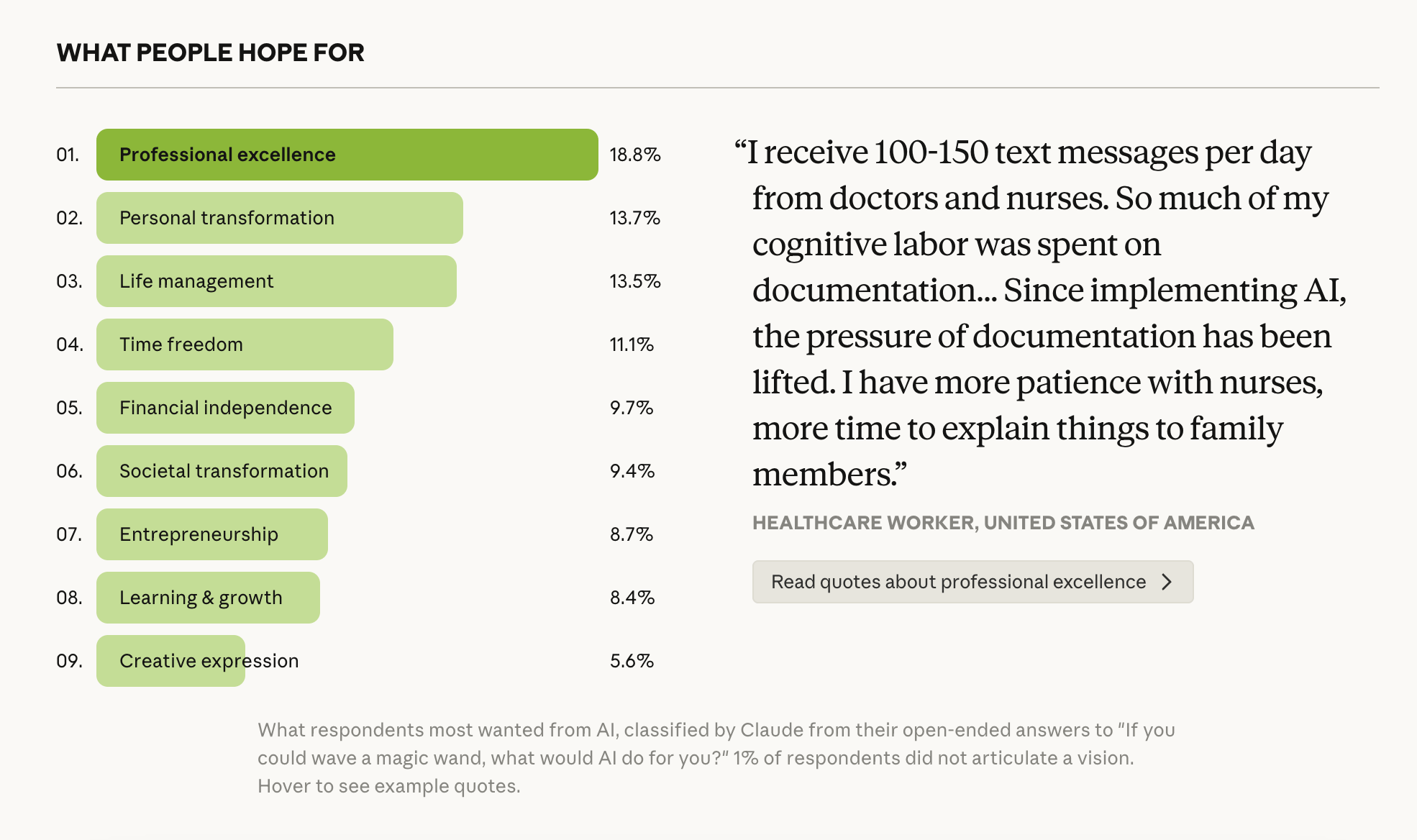
Source: Anthropic, 2026
So here's where I've landed.
People already want AI at work. The tools are already in their hands. And the research is showing, pretty clearly now, that access alone doesn't move anything. What moves things is someone sitting down with a person, in their actual role, with their actual week, and helping them see where this goes.
That's basically the work we do at 100 School, and I'll be honest it's not the exciting part. It's the piece almost every company skips and it's why most AI rollouts die after six months.
I was writing about this on LinkedIn a few days ago. $98 billion got spent on employee training last year. Only 10% of employees say that training actually changed how they work. Companies keep measuring completion rates like clicking "next" is the same thing as learning something but it isn't. Completion is a compliance metric. What matters is whether someone built something, changed something, or used AI in a way they didn't know was possible the week before.
The companies doubling their revenue aren’t using better tools than you. Your team already has everything it needs. What's missing is a map of where AI goes in your actual week, in your actual job, in the messy middle of how real work gets done. Someone just has to draw it.
How to AI 🤖
Every week, this section is your shortcut. Here are a couple of ways you could try AI this week that are worth your time:
Before you go ✌️
Who has been figuring out AI in your team? Is it unofficially you?
I've got a hunch the answer is "nobody formally" at most places and want to see if I'm right.
See you next Sunday!
P.S. Want to make your team & company AI-first? Let us help here.
