- 100 School
- Posts
- 💯 Digest: Why only 6% see real impact from AI
💯 Digest: Why only 6% see real impact from AI
What they're doing differently and how to join them.

Max Haining
November 16, 2025
Hey, it’s Max 👋
I didn’t plan on writing about another report this week. But the McKinsey State of AI 2025 report kept popping up in my feed so I finally opened it.
What really stood out to me from this report was definitely the mismatch between how widely AI is being used and how little is actually changing as a result. The parts where you can almost hear the frustration of teams trying to make this work inside old habits.
Turns out only 6% of companies are seeing real, measurable financial impact from AI.
But the interesting part isn’t the 6%. It’s why they’re different.
McKinsey basically says that the companies in that 6% redesigned how the work happens. Everyone else is doing the same thing: sprinkling AI onto the existing process and hoping something meaningful changes. It rarely does.
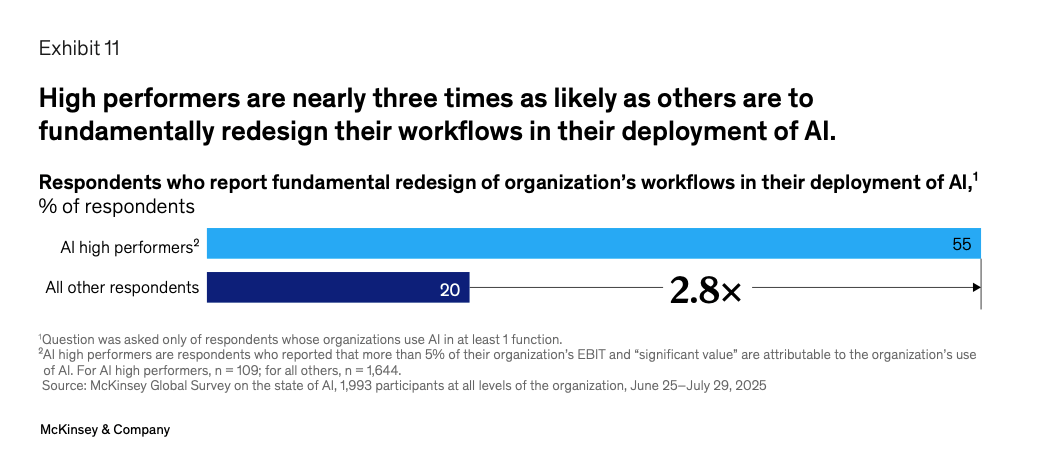
High performers are nearly 3x more likely to fundamentally redesign workflows (55% vs 20%)
That basically sums up half the conversations we have with teams. Adoption numbers look great on paper but when you zoom in, nothing underneath has actually moved. The workflow is the same, just a little faster in random places and slower in others.
It reminded me of something I mentioned in last week’s issue about how people tend to overthink AI instead of testing things together. If you’re the person that coworkers go to for AI stuff, you know that almost nobody ever stops to say “Should our XYZ workflow even exist anymore now that we have these capabilities?”
Instead, the default question is “Can AI speed up the thing we already do?” Useful, sure. But also exactly why nothing meaningfully changes.
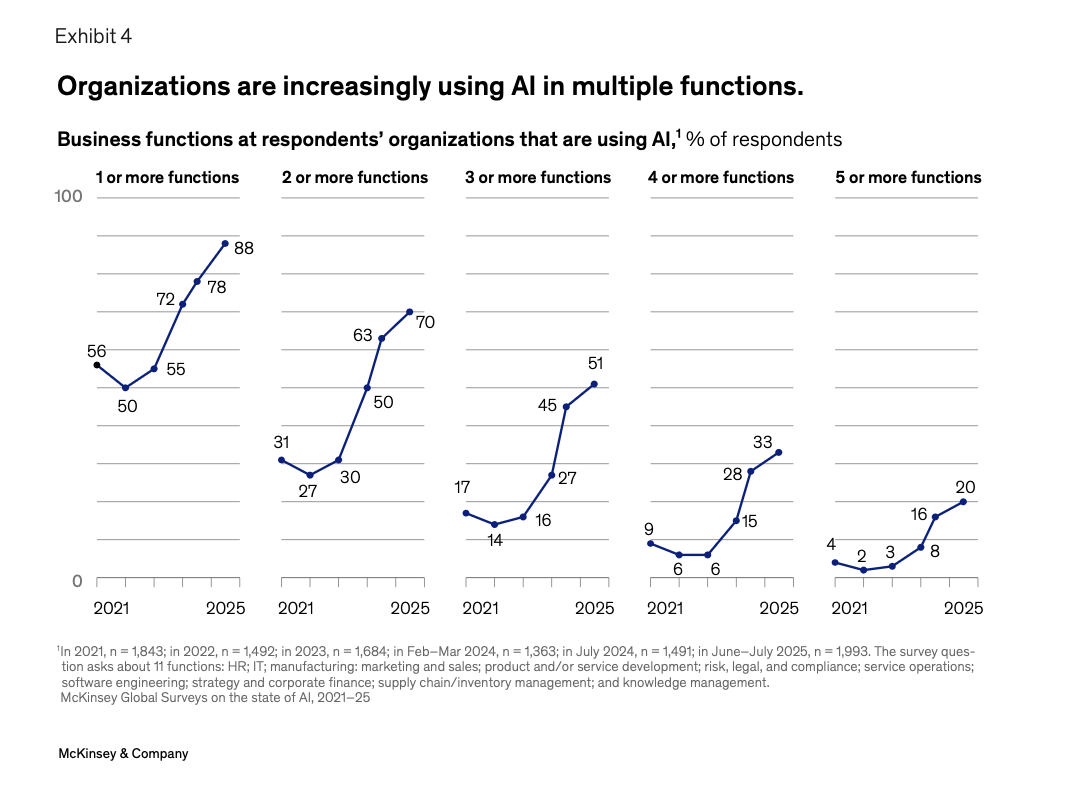
Half of all companies now use AI in 3 or more departments but nothing underneath has actually shifted.
So if you’re the unofficial AI person on your team, and I know a lot of you reading this are, screenshot this part:
The 6% who are driving real change with AI at work don’t just have more tools or better models.
They’re the ones rewriting the workflow.
And if you’re reading this thinking okay Max but what does “rewriting workflows” actually look like when I’m learning this stuff?
Good news: you don’t have to figure it out alone.
Inside every round of our challenges, bootcamps, and every team training we run, the biggest unlock comes when people stop learning AI solo and start experimenting together and that’s exactly what Harold and Ciara are helping people do this week 👇
Want help trying this stuff for real? ⚡️
This week, Harold and Ciara are running a series of free, short, live sessions for anyone who’s tired of furiously saving AI tips but never actually using them.
Here’s the lineup:
🗓️ Nov 17: How to Become an AI-First Professional in 30 Days
🗓️ Nov 18: Accelerate Your Career with AI Agents
🗓️ Nov 21st: Boost Your Career in 90 Minutes: Intro to Building with AI
Something to try this week ✅
In 2015, Leicester City won the Premier League as 5000:1 underdogs. They won because they looked at their data differently than everyone else. Instead of asking “how can we play faster?”, their analysts asked three simple questions:
1️⃣ What do we actually do well?
2️⃣ What patterns can we exploit?
3️⃣ What’s the one strategy worth doubling down on?
Here’s a tiny version of that you can use this week:

A 5min framework (DIG) that makes messy data usable
Use this anytime you’re staring at a messy sheet or dashboard and not sure where to start.
1️⃣ Step #1: D — Describe (What’s Actually Here?)
Drop your dataset into ChatGPT and ask it:
Here’s a CSV/Sheet. List all columns, show 3 example values per column, and flag missing values, weird formats, or obvious outliers. Return a short bullet list.
This forces clarity before analysis. No more jumping straight to conclusions.
2️⃣ Introspect (I)
Have ChatGPT suggest 10 questions the data could answer then you pick the top 1–2 that actually matter. Notice the importance of the human advantage: AI might give you a list of questions but you need to pick what’s the most relevant.
Paste this prompt:
Suggest 10 questions this sheet could answer. For each, say why it matters. Then pick your Top 3 and list what columns/transformations are needed to answer them.
3️⃣ Goal (G)
Choose a single question and ask AI to explore only that using this prompt:
Focus on this question: <your question>. List the exact columns and any cleaning needed. Then propose 2–3 visuals that would best communicate the answer (title + why).
This matters because it transforms scattered data points into a clear recommendation you can actually act on. It’s simple, but people are shocked at how fast this reveals hidden trends even in very small datasets.
If you want to go deeper, this is from Day 11 in our 30 Days of AI challenge. The next cohort starts in January (it’s free!), and you can join the waitlist here.
Keeping up with AI 🫠
We’re not just learning new tools. We’re learning how to work differently. These pieces helped me think deeper this week:
🤖 New release: Everyone is waiting for Gemini 3
📚 Prompts to copy: AI workflow for all your reporting
🐦 Hot take: Will AI replace developers?
📚 Another AI report: How companies are using ChatGPT
Before you go ✌️
Have you actually redesigned one workflow at work because of AI? reply and tell me about it! I’m genuinely curious what people are experimenting with.
Cheers!
Max 👋
P.S. Want to make your team & company AI-first? Let us help here.
